
A Centre Without Limits

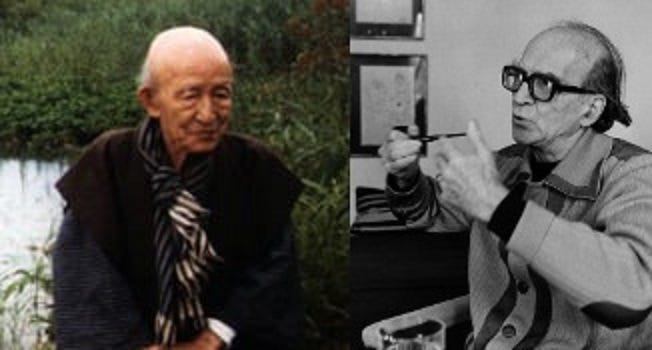
NISHITANI’S description of the fashion in which the "true self" that is the "not-self" arrives at a state of emptiness is accompanied by the notion that the fundamental basis of this selfless self lies in the "home-ground" of all other things. In other words, that the creation of a new centre even crosses over into all other centres in association with the "circumincessional interpenetration" I mentioned previously. As Nishitani himself states:
"On the field of Śūnyatā the centre is everywhere. Each and every thing in its non-objective and 'middle' selfness is an absolute centre. To that extent it is impossible for the self on the field of Śūnyatā to be self-centred like the self seen as ego or subject. Rather, the absolute negation of that very self-centredness enables the field of Śūnyatā to open up in the first place."
Man's preoccupation with the significance of a new centre has prevailed for millennia. One thinks of the legends of Agartha and Shambala or the fantastic stories of French novelist, Jules Verne (1828-1905). There is nothing quite like a fresh start or new beginning and our ancestors frequently expressed their desire to wipe clean the proverbial slate, so to speak, by creating unique cosmological points of spiritual convergence.
In his 1949 work, The Myth of the Eternal Return, Mircea Eliade discussed the architectronic symbolism of the centre. This includes sacred mountains like Mount Meru in Hindu legend, the Mount of the Lands in Mesopotamia and Mount Tabor in Palestine, all of which denote the spiritual centre of the world. There are also holy palaces and temples, like those in Ancient Babylon, each of which were connected with a divine monarch and said to mirror the cosmos. Elsewhere, there is what is known as the axis mundi, or place where the heavens above meet with the earth below in a kind of supernatural intersection.
At the root of all these interpretations, however, is the notion that the universe is being reflected on the earth. Not as a token imitation, but in terms of actually recreating and reconstructing the divine. Indeed, Eliade refers to this as the "repetition of the cosmogony," which means that the divine is actually becoming manifest on a smaller scale. The macrocosm in the microcosm. As above, so below. Once again, not as a worthless simulation, but as a timeless display of ritual and fidelity. In other words, each time this process takes place the actual creation of the world is repeated once again at that very moment. As Eliade explains:
"The Centre, then, is pre-eminently the zone of the sacred, the zone of absolute reality. Similarly, all the other symbols of absolute reality (trees of life and immortality, Fountains of Youth etc) are also situated at a centre. The road leading to the centre is a ‘difficult road’, and this is verified at every level of reality: difficult convolutions of a temple (as at Borobdur); pilgrimage to sacred places (Mecca, Hardwar, Jerusalem); danger-ridden voyages of the heroic expeditions in search of the Golden Fleece, the Golden Apples, the Herb of Life; wanderings in labyrinths; difficulties of the seeker for the road to the self, to the ‘centre’ of his being, and so on. The road is arduous, fraught with perils, because it is, in fact, a rite of the passage from the profane to the sacred, from the ephemeral and illusory to reality and eternity, from death to life, from man to the divinity. Attaining the centre is equivalent to a consecration, an initiation; yesterday’s profane and illusory existence gives place to a new, to a life that is real, enduring, and effective."
Whilst Eliade is referring to the transformative effect that sacred places can have on the individual, his work nonetheless strikes a deep chord with that of Nishitani in terms of the latter's emphasis on the radical transmutation of everyday reality. At the same time, Nishitani's selfless centres are not caught in an impenetrable bubble and thus blur the distinctions between one "real self" and another. As he suggests:
"The self is not a small, self-centred circle. Together with emptiness it is free of all outer limits [...] This is elemental self-awareness."
The field of Śūnyatā, therefore, has its centre everywhere. It also represents an absolute centre which not only bears a unique individuality of its own but also manifests "as-it-is" in relation to all things. It discovers its non-self and yet crosses other boundaries or mingles with other centres to the extent that it finds its non-self in other non-selves.