
After Schopenhauer

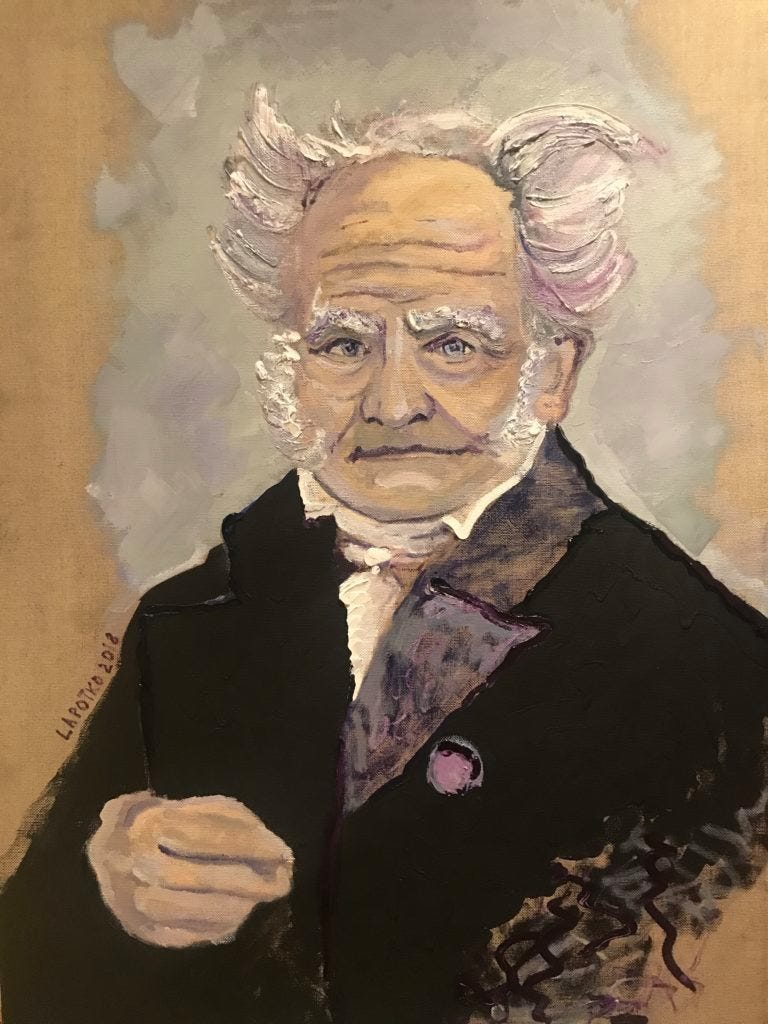
I HAVE dealt with Arthur Schopenhauer’s (1888-1860) philosophy at length on several occasions, but much less is known about the reaction to his ideas in the immediate aftermath of his death. Ironically, the collective surge of indignation came from the Neo-Kantians and these included men like Kuno Fischer (1824-1906), Otto Liebmann (1840-1912), Jürgen Bona Meyer (1829-1897), Friedrich Pausen (1846-1908), Rudolf Haym (1821-1901), Alois Riehl (1844-1924), Johannes Volkelt (1848-1930), Hermann Cohen (1842-1918) and William Windelband (1848-1915).
Although Schopenhauer had claimed that life brings more suffering than happiness, the issue that rankled the Neo-Kantians most of all was his idea that we would all be far better off if we relied purely on instinct and did not have to shoulder the burden of human reason. Naturally, for a school of philosophy that prided itself on having reduced German thought to a mere department of the natural sciences - even to the extent of forming an abortive alliance with Positivism - this clearly sent alarm bells ringing throughout nineteenth-century academia. In fact it was Schopenhauer’s revival of metaphysics which had forced the Neo-Kantians to feign an interest in the more traditional categories of philosophy in order to retain the waning interest of their rebellious students.
Schopenhauer’s quietism, i.e. the belief that it is futile to attempt to change the human condition and that spiritual contemplation remains the only effective means of achieving peace in a perpetually troubled world, had effectively suggested that the Neo-Kantian quest to promote liberal ideas was completely hopeless. As a consequence, the latter responded to the late Schopenhauer by claiming that his view of the world had no scientific basis and that it is more of a personal attitude than a well-structured argument from the perspective of metaphysics or anything else.
Apart from the fact that the Neo-Kantians felt that Schopenhauer had no right to tell others that modern life is barely worth living, they also claimed that without knowing why we exist and what our true role actually is we can never make the assumption that it is either good or bad. This, they had taken from Kant himself. Furthermore, they argued, it is impossible to divide our lives up to the extent that we try to calculate what is positive or negative about our daily experiences due to the fact that would need to take into consideration both quantity and quality. One Neo-Kantian in particular, Friedrich Pausen, suggested that it would become illogical to the point that one would have to decide how a good breakfast compares to a bowl of burned soup later in the day, or whether reading a decent book remains a positive experience when one is consistently disturbed by a noise from outside.
The Neo-Kantians also took issue with Schopenhauer’s notion that although humans derive satisfaction from things like sex and power this merely postpones our overall dissatisfaction with life. For the Neo-Kantians, taking pleasure in gratification is something that happens at the very end of a process and this should be contrasted with the pleasure of doing. In other words, the satisfaction we feel in the wake of a sexual orgasm, or perhaps after eating a nice meal, is rather different to the active pleasure we derive from playing an instrument or swimming in a lake. After all, the instrument has already been learned and swimming need not involve fulfilling a goal of any kind. Furthermore, many human actions have a higher purpose than simply releasing an individual from the pain of desire, such as sexual activity leading to procreation or an instrument providing pleasure for others. As far as Schopenhauer’s belief in the actual will itself is concerned, Alois Riehl insisted that by confining it to individual acts and removing the question of motives and ends he was confusing will with basic instinct and desire.
The Neo-Kantians then attacked Schopenhauer’s belief that the will is the guiding force behind the intellect on account of seeking to establish the means by which humans can get what they want on account of his simultaneous contention that we can deny the will by way of intellectual insight. Riehl, Fischer, Meyer and Haym saw this as a gross contradiction because if the intellect is the servant of the will it cannot possibly lead to any form of cerebral liberation.
Finally, despite this well-organised and strategic attempt to shoot their predecessor down in flames, the true reason behind what has since become known as the ‘Pessimism Controversy’ relates to the liberal views of the Neo-Kantians themselves. Schopenhauer’s advocacy of a new breed of European thinkers who, as Julius Evola (1898-1974) noted less than a century later, could learn to ‘ride the tiger’ in the face of what appears to be an imperfect world, was seen as a huge threat to the vigorous Neo-Kantian support for Republican constitutionalism and the spurious values of liberty and equality as they have been framed by the architects of modernity.