
Barfield and Bellow

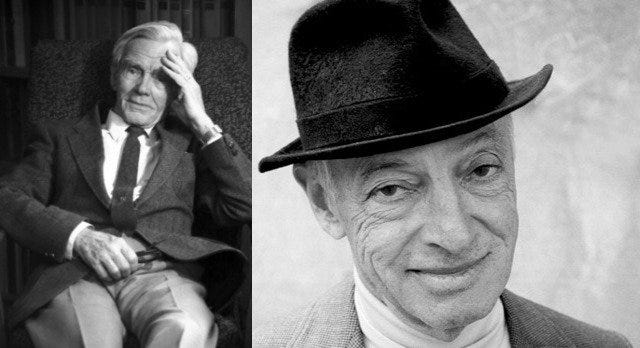
I HAVE been delving into the beguiling correspondence that took place between the philosopher of consciousness, Owen Barfield (1898-1997), and the considerably more famous Jewish-American novelist Saul Bellow (1915-2005). The former - a close friend of both J.R.R. Tolkien (1892-1973) and C.S. Lewis (1898-1963) - was undoubtedly stuck in his ways, which isn't such a bad thing, but I sensed a certain tragedy in that Bellow kept asking the older man to review his novels and then finding himself bitterly disappointed when his English counterpart reacted so unenthusiastically towards them.
I found their letters to be a conflicting and yet cordial insight into an ironic attempt on the part of a self- described Modernist author to transcend American values as they appeared in the 1970s. Ultimately, whilst Bellow's encounter with Barfield's own work led him to embrace the Anthroposophical ideas of Rudolf Steiner (1861-1925), something he tried to incorporate within the plot of his 1975 novel, Humboldt's Gift, Barfield's primary concern with the decline of the human spirit is irreconcilably at odds with Bellow's insistence that one must retain the structure of modern society in order to better understand it. As Simon Blaxland-de Lange explains, as far as Barfield was concerned
"American culture, as chronicled in Bellow's novels, was to Barfield merely an extreme and one-sided development of a particular stage in human consciousness which he traced back to the Renaissance and associated especially with those Western European peoples which had been in the forefront of establishing the world-view of scientific materialism and the particular life-style that is characteristic of today's world."
In that respect, Bellow was not even the Modernist he claimed to be and this leaves us with a curious paradox. Barfield, perhaps unexpectedly, was far more 'in touch' with the true nature of the modern world in that he was able to trace its origins back to the fifteenth and sixteenth centuries. Besides, his lifelong interest in the evolution of consciousness meant that Barfield's philosophical outlook was profoundly more 'forward-thinking' than Bellow's literary Modernism because he was of the opinion that Western humanity's obsession with technology and material prosperity does not represent any significant form of advancement and that a more authentic leap forward - one based on intensely spiritual considerations - was yet to come.