
Being There

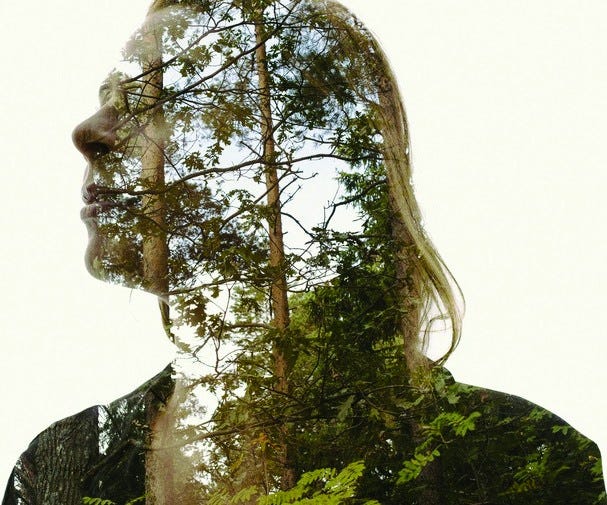
DURING my previous incarnation, back in England, I was always something of a geographical pedant. Whenever I heard somebody announce that they were intending to "travel to Europe," a common expression in those parts, I was never able to resist the overwhelming urge to remind the person in question that he or she was already standing on European soil. This reminds me somewhat of what Friedrich Schelling had to say about the bifurcation or division of nature in his famous Freedom essay of 1809. Confused? Allow me to explain. As the American professor, Jason M. Wirth, has noted:
"Such a conception characterises modern philosophy's nature-cide by denigrating nature into an object that can to some extent be pried open from the vantage point of the subjective position of scientific enquiry. This assumes that nature stands before us as a vast conglomeration of objects and internally recursive laws that govern their manners of relation to each other."
Schelling, for those who know their Romantic philosophy, completely dismissed the subject-object relationship and believed - as Gottfried Wilhelm Leibniz had before him - that everything is comprised of a single substance. We can see the enduringly fallacious tendency for humankind to view nature as something independent of itself in the way that modern academia likes to discuss both human and natural history in entirely separate terms.
Returning to my irritating habit of reminding other English people where they are on the planet, it is possible to present Schellingian philosophy in a similar way. Indeed, by replacing the prospective traveller on his or her way to visit another European country with a person who happens to be admiring a pleasant landscape, we are almost certain to hear the latter express their admiration for the sheer "beauty of nature," but an appropriate response - and one which is possibly just as tedious and pedantic as my previous rejoinder - would be to ask whether they are talking about their own beauty, that of a distant hillside or the undifferentiated Absolute itself. In the words of Maurice Merleau-Ponty, Schelling "places us not in front of, but rather in the middle of the Absolute" and viewed from this angle it seems rather superfluous to address nature as something that is independent of oneself.
To present this little exercise in interrelationality in a more spiritual context, especially with regard to my geographical example, someone like Hilaire Belloc would contend that "Europe is the faith and the faith is Europe," whilst to quote Schelling in relation to the second: "Nature is visible Spirit; Spirit is invisible Nature."
Fuck my old boots - that hits the bullseye!