
Friedrich Schelling's Radical View of Nature

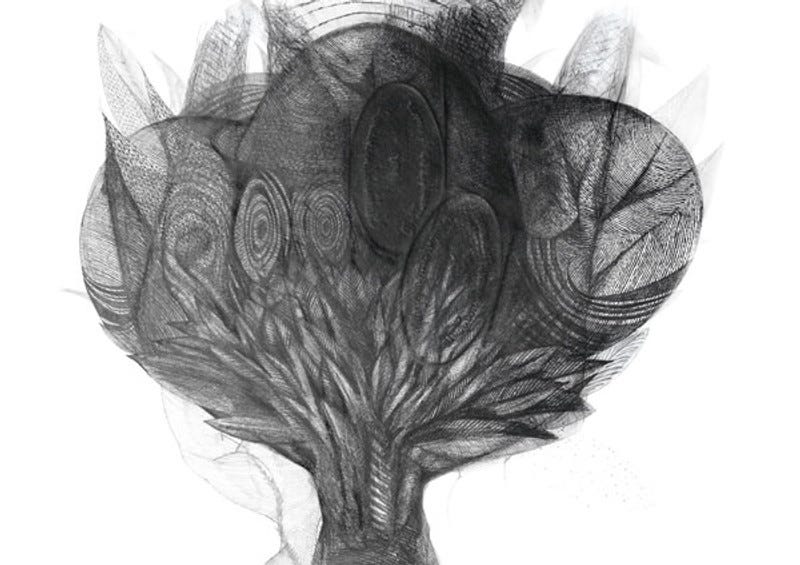
YEARS ago, when I was home-schooling my children, I would try to convey the importance and value of the natural world by reminding them of the organic things that surrounded us in the home. I would tell them how the potted plants, for example, the fish in the aquarium, our resident Bassett Hound and even ourselves - not to mention the occasional insect scuttling around the room - were all part of nature and that objects such as chairs, tables and writing materials were not.
Needless to say, the fact that I later became an Absolute Idealist fundamentally changed my perspective on such matters and it was Friedrich Schelling who impressed upon me the idea that nature isn't simply there for us and neither do we belong to it. We are no more in nature than we are in time, simply because everything around us is alive. In Schelling's own words, taken from the System der gesammten Philosophie Nachlaß (1804–1807), looking at the world in this radical new context
“must be the fruit of a universal philosophy that leads humans back to nature so that nature teaches the more cheerful contemplation of the world and of humans; so that nature teaches one to contemplate actions and things not in relation to the subject but rather in themselves and in relation to the order of nature.”
Schelling is not talking about natural law, because the spirit of nature cannot be contained within the straightjacket of codified dogma and continually exceeds its own boundaries in the way that the future must always move beyond the present. This means that man cannot lust after nature as one might strive for religious purity, but must do the complete opposite by detaching oneself from anything that conflicts with the idea of nature and thereby affirm nature itself. We do not become nature, because we are already one and the same thing; a thing over which we have no justifiable claim.
What has been described as “the soul of the genius,” or Weltseele, is born out of itself by way of divine imagination and yet these forms of life never wear out the life of forms. In other words, the former - being ourselves and everything around us - relates to life itself and the latter to those eternal forms which, like Goethe's Urpflanze, act as a blueprint for the life that is yet to come. As John Sallis explains in Force of Imagination: The Sense of the Elemental (2000):
“There is something monstrous about genius. It is the site where—the passageway through which—nature, by giving the rule to art, gives rise to something that, though born from and set within nature, nonetheless exceeds nature. [...] Is it not because of this monstrosity—because he at least caught a glimpse of it—that Kant insists on the requirement of taste, that taste is required to discipline genius, to clip its wings, to make it civilized or polished, to provide it with guidance, to introduce clarity and order?”
As a philosopher, Schelling went further than Kant in the sense that he believed one must have a degree of madness in order to achieve a deeper understanding. As John M. Wirth explains in The Conspiracy of Life: Meditations on Schelling and His Time (2003), without madness
“reason is tyrannized by the dogmatism of the intellect and the clarity of shallow understanding, or it collapses into the chaos of sensibility utterly detached from the intellect. Madness would be something like immediate Empfindung [sensation] without the capacity to translate its abyssal descent into human language.”
The words here are slippery for me, but I like it. To garble Goya, The dreams of Reason excised from ecstasy produce monsters. The dreams of Ecstasy excised from reasom produce insanity.