
Going Underground

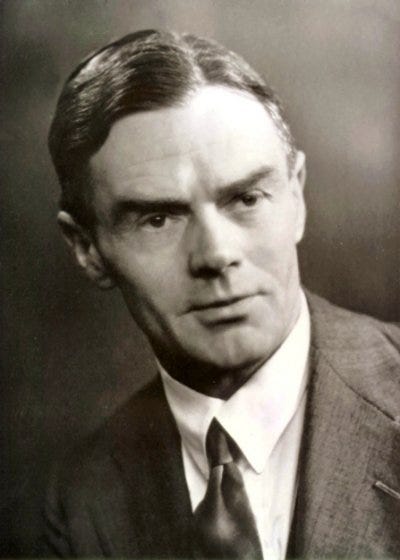
OWEN Barfield devoted a significant amount of time to the historical factors that had derailed the evolution of human consciousness, but when he finally came to discuss the long-term consequences he did so through the medium of science-fiction.
Firstly, even though it is often accompanied by a sense of isolation from the world, Barfield accepts that individual self-consciousness is crucial in that it allows us to become aware of ourselves as self-directing entities that value the principle of liberty. Alienation, after all, is a perfectly natural stage in the evolution of consciousness. The real problems occur when self-consciousness is perceived as something that is either permanent or an ultimate end-goal of human development. By continuing to distinguish ourselves from the world, Barfield contends, we treat everything outside of the self as "idols" and it is this mentality which pervades the modern mindset. As I explained a few days ago, this is depicted as a form of escapism that allows the individual to avoid coming face to face with true reality and the fact that we are still in dire need of self-development.
One of the few documents in which Barfield tried to deal with the psychological impact of externalised idolatry is the 1975 work, Night Operation. Although it was initially rejected by a number of different publishers, it is here that he attempts to warn his readers about the dangerous trajectory of materialism. Night Operation is a science-fiction novel in which humanity has been driven underground by a fear of political extremism. Rather like our own dystopian existence, Barfield's tale portrays a society obsessed with security to the extent that people are living in a state of perpetual anxiety. More importantly, the book reveals that mankind finds itself at an existential crossroads in which the very future of human evolution is at stake.
Of course, as a fully-fledged member of the Inklings a man like Barfield had big boots to fill if he was to follow in the footsteps of lifelong friends J.R.R. Tolkien and C.S. Lewis, but although Night Operation received a mere fraction of the public interest commanded by the likes of The Hobbit (1937) or The Lion, The Witch and The Wardrobe (1950), it was a far more ambitious work in the sense that it sought to address the ills of contemporary society and the perilous direction in which humanity is headed.
Shortly before embarking upon the novel, Barfield had tried to organise a symposium based on the 'Threefold Commonwealth' of Rudolf Steiner, but whilst his efforts were unsuccessful the introductory statement he had written to accompany the event tells us something about his main concerns at the time:
"The complex industrial society of the Western world is at the moment waking up to a deadly serious problem. It is the fact that, because of that very complexity, small groups of individuals here and there are in a position to enforce their will on a whole community. Terrorists holding nations to ransom with kidnapped hostages are only the extreme example. The power does not defend on outright lawlessness. Workers in a single industry, for example, need only threaten to withhold their labour indefinitely and, so intimate is the inter-dependence between one industrial structure and a great many others, that ruin may stare us in the face."
Written at a time when England was facing a serious economic crisis, itself the result of a massive oil shortage, Barfield's remarks became the basis of his futuristic novel. In her prefatory note to A Barfield Sampler (1993), Professor Jeanne Hunter describes Night Operation as
"a contemporary allegory on the fall and potential rise of humanity represented in the character of Jon, a voice crying in the wilderness of modern humanity."
Born into a hellish world for no other reason than the fact that his mother had reluctantly decided to endure the "messy" business of childbirth at a time when millions of other children were being aborted with alarming regularity, Jon had "slipped" into being and then gradually become familiar with the realisation that existence in the twenty-second century was about surviving what amounted to one vast sewer. The boy's teacher would only allow him to glimpse the sun, the moon and the stars through a thickly glazed window, whilst the three R's so familiar to modern English education (reading, writing and arithmetic) were replaced by the three E's: ejaculation, defecation and eructation (or, in the colourful language of Barfield's novel, "fucking, shitting and puking").
All forms of culture and learning are discouraged, with the rulers of this dystopian civilisation insisting that it is crucial to "avert elitism by scotching discrimination". Sound familiar? To quote the school principal, "we cannot all think, but we can all excrete." Preoccupied with the male penis, many occupants of this underground realm are constantly trying to incorporate the function of the anus into mainstream sexual discourse, whilst others - the 'Nauseants' - are completely obsessed with the sado-masochistic implications of vomiting.
Finding himself at odds with this degenerate way of life, Jon discovers a way out after hearing an elderly woman with a speech defect utter a series of antiquated linguistic peculiarities that encourage him to study the meaning of language. Entering the Inner History Museum, where he undertakes a secret study of human development, Jon - like his literary creator - realises that language holds the key to the world of light and, along with two friends, manages to avoid the notorious bureaucracy of the Personal Records Office and arrange a visit to what is known as "Aboveground".
On the one hand, the world of light is a post-apocalyptic landscape in which the errors of humanity have run rampant and, on the other, a spiritual reflection of twentieth-century Christianity. At this point, the trio of adventurers experiences a "monstrous happening" involving a number of small golden objects parachuting to earth. These objects disappear into the ground, whilst their mysterious supports return to the heavens. What follows, is a description of how each individual observes the souls of human beings as they incarnate upon the earth.
Jon witnesses a "little ghostly Cup" that is constantly refilled with "magic Provenance awfully beheld". This is interpreted as the past of humanity and the birth of individual beings as a consequence of the Word. When the falling objects turn black, however, they are seen as a vision of future humanity and its transformation into some kind of collective excreta. Although Jon is extremely unwilling to return to his native "Underground," he is persuaded to do so by his two friends and together they begin to decipher the esoteric knowledge they have gleaned from the surface. Keeping his readers in suspense, Barfield concludes the novel by leaving it open-ended:
"What happened after that, how far they maintained their joint resolution, what influence they were able to exert, and what effect, if any, it had on the destiny of that closed society of sickness and the smell of sickness, from which they had momentarily emerged, is a tale that cannot be told for the sufficient reason that it is not yet known."