
Mirrored Reflections

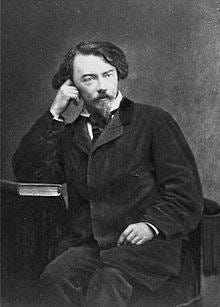
IN Auguste Villers de l'Isle-Adam's (1838-1889) novella, The Desire to be a Man, we are introduced to a flamboyant Parisian actor by the name of Chaudval. As this tragedian performer strolls down the city's notorious Boulevard du Temple on his way home from the theatre, he catches sight of himself in a public mirror and is shocked to note that his famous grey hair is beginning to turn silver. Caught in the throes of a sudden crisis, Chaudval realises that he no longer knows who he is and that after a lifetime on the stage he has become such a complex jumble of characters that he has relinquished his own identity:
"Here it is nearly half a century that I have been impersonating, that I have been play-acting the passions of others, without ever feeling them myself - for, deep down, I have never felt anything."
From that moment on, Chaudval is determined "to become a man" and decides to retire from the acting profession altogether and take over the running of an old lighthouse on the northern coast, as his less complicated ancestors had done before him. For the present, however, still perched before the full-length mirror in an empty Parisian street, Chaudval begins to consider ways in which he can form a new personality:
"Love? - Too late. Glory? - I've had my share! Ambition? - Let's leave that trash to politicians."
It is then that he decides to stimulate his suppressed emotions through remorse. If he can commit a monstrous outrage of some kind, then he will have the pleasure of being eternally pursued by the kind of conscience-pricking ghosts that plagued the likes of Hamlet, Nero and Macbeth. He finally settles on becoming an arsonist and, throwing a stone at his reflection and shattering the mirror into a thousand pieces, Chaudval continues on his way.
Several hours later, a huge conflagration illuminates the neighbourhood of Château d'Eau and a handful of matches tossed into a pile of flammable material has left almost one hundred people dead and a further one hundred families homeless and destitute. Taking the first train out of the city, Chaudval flees to his ruined lighthouse and expects to be haunted by the unremitting spectre of penitence and contrition:
"What sleepless nights I shall savour, surrounded by the vengeful ghosts of my victims! I feel welling in me the soul of Nero, burning Rome for artistic exaltation! Of Erostratus, burning the temple of Ephesus for love of glory! Of Rostopchin, burning Moscow through patriotism! Of Alexander, burning Persepolis as a chivalrous gesture to his immortal Thaïs!"
Thus, Chaudval is enveloped by an overriding sense of bliss and yet when he is alone within the drab walls of his remote abode feels no remorse whatsoever and therefore fails to detect a single ghost. Chaudval then attempts to lure unsuspecting ships onto the rocks, although that, too, fails to conjure up visions of the slain:
"Sterile crimes! Wasted efforts! He felt nothing. He saw not a single threatening phantom. He could no longer sleep, so choked was he by despair and shame."
Villers de l'Isle-Adam's short work of nineteenth-century fiction concludes with his self-obsessed character dying of a cerebral seizure without ever realising that the only 'ghost' he was searching for was himself. In many ways, the story resembles that of Fyodor Dostoevsky's (1821-1881) Crime and Punishment, in which Rodion Raskolnikov murders a pawnbroker in an effort to transcend the crushing poverty and degradation of St. Petersburg and become 'Napoleon' for a day. Consequently, a prostitute by the name of Sofya Marmeladova encourages him to confess his crime to the police and Raskolnikov goes on to experience remorse for his actions. Dostoevsky's novel appeared in 1866 and Villiers de l'Isle-Adam's in 1883, so it seems likely that the latter was influenced to some extent by the work of his Russia predecessor. Whilst Dostoevsky's novel was about forgiveness and Christian redemption, his French counterpart was both a Decadent and a Surrealist who decided to approach the question of remorse in a fundamentally different manner.
There are similarities between Raskolnikov and Chaudval in that both men were experiencing an existential crisis, but whilst one suffered imprisonment on the path to spiritual fulfilment the other died in turmoil as a free man. This is not to say that Dostoevsky's approach to the matter of human anguish is preferable, of course, only that the human condition itself was already undergoing the kind of civilisational disillusionment which, one century later, would reveal itself in the writings of Jean-Paul Sartre (1905-1980), Albert Camus (1913-1960), Colin Wilson (1931-2013) and various others. In many ways, Dostoevsky and Villiers de l'Isle-Adam were acting as a bridge between the ideas of Søren Kierkegaard (1813-1855) - whose first work was published a full two decades before Crime and Punishment - and the twentieth-century existentialists themselves.
The 'moral' of Villiers de l'Isle-Adam's little tale? Do not attempt to conjure up the ghosts of others but, instead, concentrate on cultivating the daimon (δαίμων) that lies within.