
Pascal's Wager

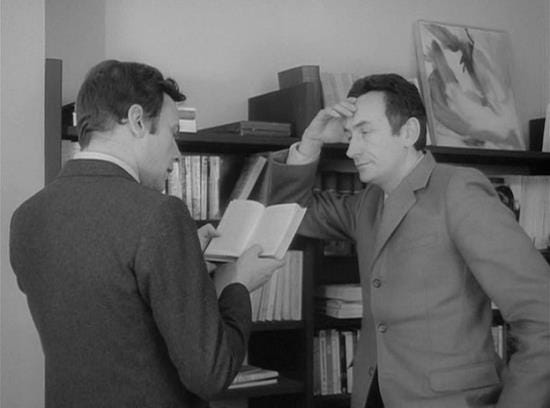
IN Éric Rohmer's 1969 film, Ma nuit chez Maud (My Night at Maud's), a practicing Catholic and his Marxist associate have a conversation about the philosophical concept known as 'Pascal's wager'. The idea first appeared in 1670 as part of the Pensées, Blaise Pascal's (1623–1662) posthumous work on Christian apologetics.
In the film, the leftist employs two basic hypotheses in order to illustrate how the wager operates. The first hypothesis denies that history contains any meaning whatsoever, whilst the second insists that history does indeed possess a sense of meaning. The outcome of this intellectual discussion is that even if it seems unlikely that life has any meaning at all, at least to the French protagonists in the film, only by accepting the second hypothesis can we justify our own existence. To live by the first idea, in other words, is to throw away one's life and therefore self-justification must lie in the second. The Marxist, a university lecturer, has chosen to stand by this fact even in the face of what he regards as overwhelming odds. The Catholic, a mathematician, agrees that whilst the first hypothesis represents 'potential gain divided by probability,' in the second 'the probability is slight but the possible gain is infinite.'
There is agreement between the two men in that the Marxist, at a time when French Existentialism was already on the wane, is trying to add meaning to his life in the way that Pascal was seeking eternal salvation and insisting that people must live as though God's existence were irrefutable. Our entire lives, he says, is about making the right choice. In Pascal's own words,
"Belief is a wise wager. Granted that faith cannot be proved, what harm will come to you if you gamble on its truth and it proves false? If you gain, you gain all; if you lose, you lose nothing. Wager, then, without hesitation, that He exists."
In short, Pascal believed that man is incapable of deciding whether God exists through reason alone and therefore the decision itself represents the ultimate philosophical gambit: a choice between the finite and the infinite. However, from a more orthodox Christian perspective - and Pascal was a Jansenist - it is difficult to see how the conscious suspension of one's mental faculties in the quest to secure everlasting life (particularly for an atheist) can ever become a substitute for the more traditional leap of faith.
Given the consequences of living without God, Pascal even suggests that we do not actually have a choice at all. Whilst the film never returns to this theme, at least from any meaningful perspective, nothing is ever said about the potential for humans to add meaning to their own lives, so in the face of such powerlessness the wager becomes a form of persuasive determinism. In addition, unlike placing a bet on a horse-race there is no assurance that the gambler will ever receive his winnings. If, indeed, the horse does actually cross the finishing line.