
Schelling's Mystical Interpretation of Art

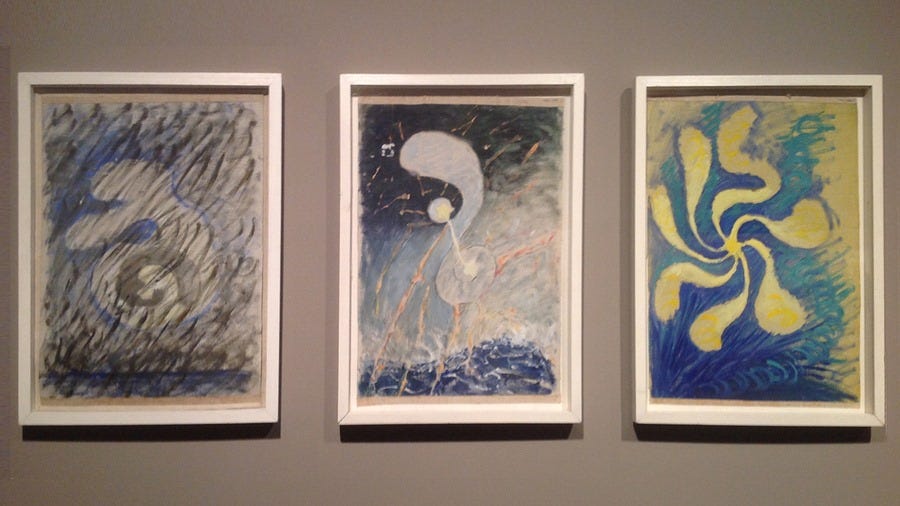
PERHAPS the easiest way to describe Friedrich Schelling's ideas concerning the manifestation of the divine through nature, of which we are part, would be to think of gravity as a hidden God that reveals itself through light. In other words, visible life is projected from an invisible realm as an image of the revelation without representation. This unusual state of affairs may be explained through the medium of art.
Whilst it would be impossible for an artist to represent something that he or she has never seen, in this case an image of the ungrounded divinity within the abyss, a large number of people will try to capture what they have witnessed in nature by way of exact reproduction. We often describe these images as examples of ‘still life’ and yet it seems ironic that this very term is nothing more than a representation of something that is entirely dead and lifeless. In Book 10 of the Republic, when Plato banishes the tragic poets from his sight, he does not undertake such action on account of their lacking talent but due to the fact that their work was far too realistic. As Jason M. Wirth explains,
“they provided pictures of representations that they uncritically passed off as the real rather than producing images as the real.”
Plato was rightly committed to the vigorous defence of imagination in the face of mere repetition. Needless to say, there is little imagination in excessively literal poetry or the umpteenth bowl of painted fruit. When Schelling tells us that nature is an image of the revelation without representation, therefore, he means that it emanates from a hidden source but in a completely different guise. However, whilst it seems impossible for an artist to produce an image of something that he or she has never encountered, in the way that God reveals himself through nature, it is possible to achieve this in a non-representational fashion.
By producing works of art that seek to bring the formless into form, the artist enters into a process of creative intuition. The result of this unconscious activity brings about an identification with the infinite. Although the infinite itself cannot be copied at first hand, it is nonetheless possible for an artist to employ his or her imagination as a means of facilitating a mystical alignment with the primordial. This happens when genius arises from what Schelling described as the “indwelling divine” in the way that a veiled deity reveals itself through nature. As far as he is concerned, “God is the absolute cause of all art.”