
Some things Never Change

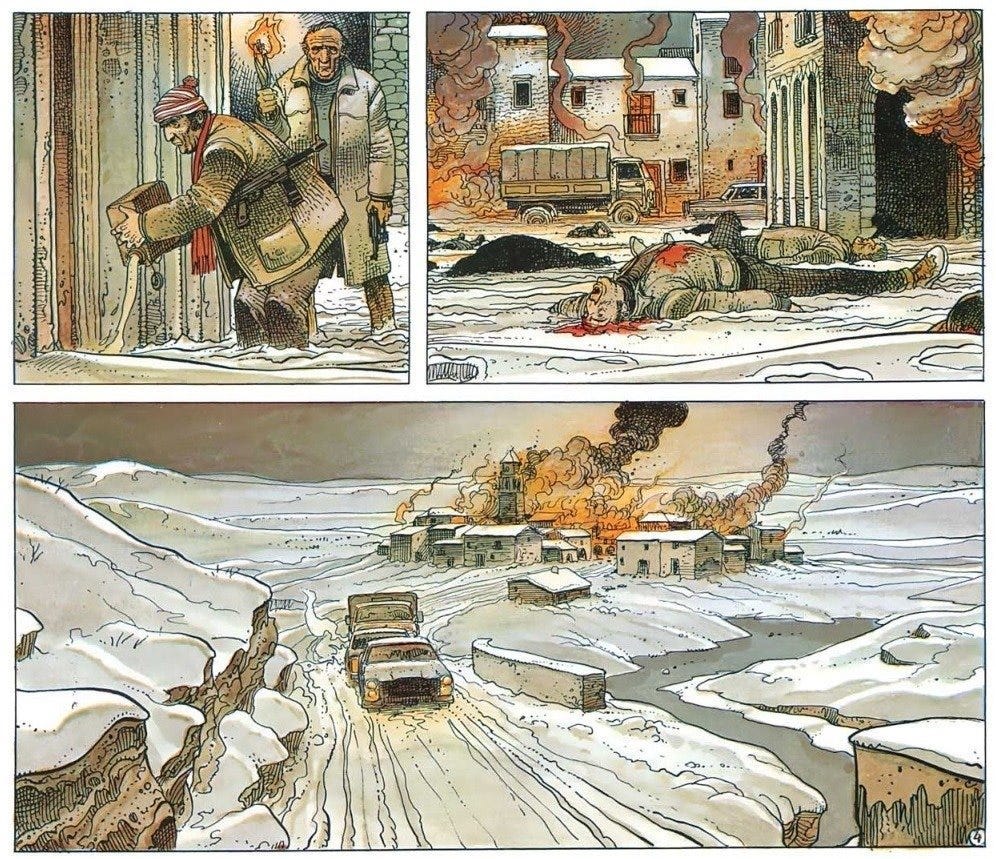
MANY years ago, I came across a graphic novel that had been written by Pierre Christin and illustrated by Enki Bilal. Originally published in France and entitled The Ranks of the Black Order (1979), it concerns what are described as “the ultimately pointless struggles of left- and right-wing militants” during the Spanish Civil War of the 1930s.
Set at a time when the conflict itself was becoming a distant memory, and following a ruthless massacre at a small village by a fascist paramilitary, their outraged communist adversaries decide to reform. As the story develops we discover that there are two groups of elderly men committed to reviving old hatreds and of destroying one another once and for all.
Out in the real world, the deluded foot-soldiers of the Far Right and the Far Left are still engaging in the kind of futility that was so dramatically portrayed by Christin and Bilal. Not in the sense that these people are even capable of waging any kind of armed struggle against their opponents, but the same tedious battle-lines are being drawn in the sand.
As the Right-wing fantasists congregate beneath the banners of their latest party political coalitions, concealing their true motives, their Leftist counterparts are behaving in the same manner and yet pretending to care about the plight of ordinary people. This tired process has been going on since the 1920s, a full century, and the fact that it is still taking place after so long demonstrates just how useful this tried and tested method of divide and rule is to the nation-states of the world.
As the steam pouring from these complementary pressure valves continues to drift across the mocking city skylines of Europe and North America, the rest of us will be reaching for the off-button lest we bore ourselves to death with the same old film that we have seen time and time again and in a multitude of different languages.