

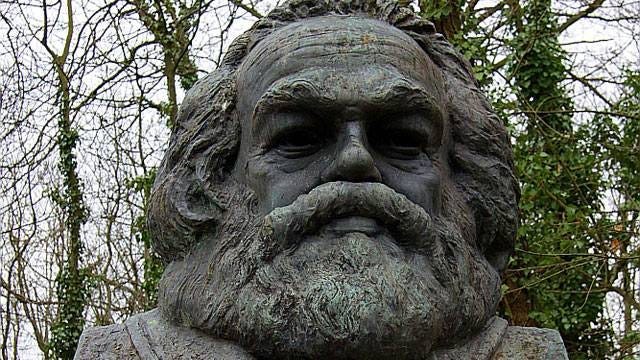
I HAVE often discussed why I completely reject the wildly reductionist notion of ‘Cultural Marxism,’ one of the Right’s more dishonest attempts to make excuses for the multifarious ills of capitalist society, but whilst left-wing think-tanks such as the Frankfurt School clearly have a lot to answer for and, undoubtedly, played a crucial role in both the ideological formulation and eventual praxis of the Left during the course of the twentieth-century, it is far too simplistic to imagine - even for one moment - that there has ever been an unbroken chain of socio-cultural decay that is directly attributable to the Frankfurt School alone or to Marxists in general.
One way of disproving the alleged supremacy of Marxism in the academic sphere, for example, is for younger people to familiarise themselves with some of the political and biographical works that were produced during the 1970s. Marxists had certainly enjoyed an influence in many European universities, without a doubt, something that culminated in the famous student riots of 1968, but it would be far too convenient to suggest that they had it all their own way or to discount the concomitant and, indeed, consequent opposition to Marxism itself.
Many of the writers and social commentators of the early-1970s, no doubt as part of an orchestrated capitalist response to Marxism and its command of young intellectual minds during the previous decade, set about criticising and dismantling some of the chief exponents of left-wing ideas, be they old-school Marxist, Existentialist, Structuralist, New Left, Deconstructionist, Poststructuralist or Postmodernist. I am not talking about a handful of obscure authors, either, because a concerted and collective effort was made by many of the mainstream publishers to completely nullify and render obsolete the more dangerous effects of Marxism and that which was once considered extreme soon degenerated into the preserve of the white-haired professor who may harbour a few left-wing views and produce the odd Marxian text but rarely ever set the cat among the campus pigeons by risking his comfortable position in the Humanities department.
Marxism, therefore, once perceived as a serious threat by our capitalist masters, or at least presented as such, has now become a bankrupt ideological dinosaur that is only tolerated to the extent that it is never permitted to affect the smooth, day-to-day running of the economy. In short, Marxism has become a useful pressure-valve. So again, if you want a more realistic and semi-objective perspective about the perceived influence of Marxism, as well as its various philosophical permutations, try reading a few old texts in order to examine the way in which it was effectively sidelined in the wake of that heady Parisian spring. Like most common delusions, the spectre of an eternal and vigorously influential Marxism is really all in the mind.
Yes, never the dominant ideology of universities, but certainly in many humanities departments Marxists became one of the loudest voices. Perhaps with good reason, because they presented key understanding that power-elites determined much of what was happening nationally and internationally, and thse elites were complex constaellations of sociopaths who commanded the main institutions in the economy, poilitics, and mainstream culture and media. But there was an earlier generation of British Marxists of the 1950s whose books were on almost all undergrad reading lists of their subject. In history, EP Thompson's Makig of the English Working Class was ubiquitously praised by all lecturers I knew of no matter what their politics. Hobsbawm and R Willaims a bit less so, and then Christopher Hill and Raphael Samuel. These writers, apart from Williams, wrote clearly and withou too many implicit references to other writers or theories that a lay reader might not have heard of. Williams first two books are reasonably clear, but nothing like the other writers here mentioned, and his later work became nearly as eccentric and esoteric as the works of the next generation of Marxists in 'cultural studies' whom he opposed). Thompson never succumbed to the fog of angry obscurantism (see Alice Miller's devastating critique of academics as petty sadists making the lay reader suffer the very same obscurantism that they had to suffer as undergraduates) that this generation of structuralist, post structuralists etc.indulged in and he slammed them in his essay and lecture The Poverty of Theory. I blame Althusser, whose truisms allied to asinine attempt to deny agency to human beings, became the sacred text of the New Left in universities ay least by 1980s. I had no idea that such an asshole could flim flam UK intellectuals until I joined a humanities department, and the resident Marxist proudly old me that Althusser was now the dominat theorist in intellectual Marxism, which he called 'libertarian Marxism' to distiinguish ot from 'vulgar marxism.
Much of the contemporary use of the term Marxist assumes that Mraxist theory aims at a permanent State Socialism (Dictatorship of the4 Proletariat by a few intellectuals. As I understand it, most Marxists and socialists aim at the withering away of the state and permanent anarchy. Howver i am told that some socialists aim at a permanent state (eg Fabians). is this so?