
The Outside is Inside

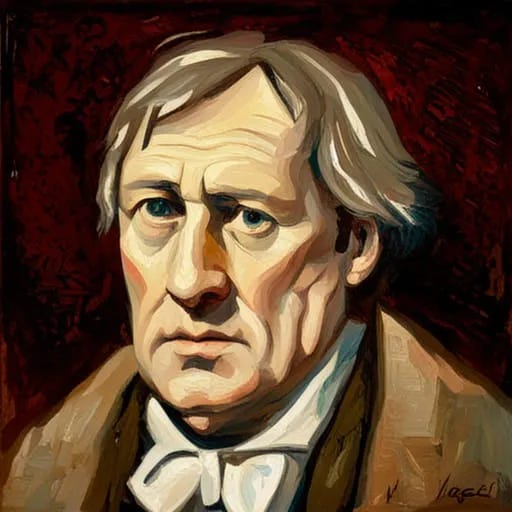
THE philosophy of G.W.F. Hegel (1770–1831) was influenced by the illusory shadows that flickered upon the walls of Plato's allegorical cave, especially in the sense that reflections of this kind must represent either Being or not-being. At the same time, Hegel understood that the unity of all things involves a Whole that cannot be opposed to any form of otherness. Unlike the relationship that exists between each finite thing, such as ourselves and the objects around us, this Whole is never measured against anything outside itself; for there is nothing that lies beyond it. Whilst this seems to imply that the Whole may nonetheless be juxtaposed with nothing, i.e. something that is other than itself, this other must inevitably be contained within that same Whole. This fact does not prevent the other from representing the Whole's other self, either, because otherness relies on negation and this means the process must involve some form of determination. If not, then the lack of an other would render something like the universe indeterminate and featureless. It would be a positive in lieu of a negative, or an identity without differentiation.
Contrary to his predecessor, Immanuel Kant (1724–1804), Hegel dismissed the idea that negation is little more than a form of erasure. Indeed, the overcoming of the positive by the negative should not imply that the positive is completely vanquished and rather than be interpreted as two temporal stages the positive and negative must be seen as a brace of inseparable 'moments'. The positive does not exist for the purpose of being eradicated by the negative, it continues to assert its own individuality. This is why the Whole always contains its alternative self, although that alternative self remains part of the Whole and this can only be achieved - according to Hegel - if the Whole is perceived as absolute spirit.
The logical formula for this is A=not-A, although each part of the equation operates within a common system and not as an isolated opposite. This may be compared to the manner in which odd and even numbers are part of the same numerical sequence. The entirety of the universe is thus divided between A and not-A, meaning that Hegel's dialectic rests on an oppositional reality that simultaneously provides contradiction and distinction.