
Touching Eternity

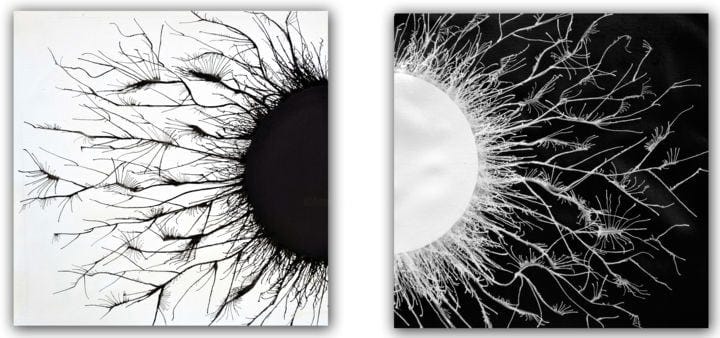
NISHIDA’S late essay, 'The Unity of Opposites,' is a ten-page manuscript that deals with the juxtaposition of the finite and the infinite and is designed to address the dualistic concepts that one finds in Western thought. This examination of what some have described as the coincidentia oppositorum takes into account the philosophical bipolarities of good-evil, subject-object, reality-illusion and inside-outside, all of which have been explored by mystics and thinkers such as Lao Tzu (d. 531 BCE), Friedrich Schelling (1775-1854), C. G. Jung (1875-1961) and Alfred North Whitehead (1861-1947).
I have already discussed Nistitani and his concept of jitai ("in itself"), or "absolutely non-substantial substantiality," and Nishida arrived at a similar conclusion in relation to a non-dualistic self-identity of an absolute two that ultimately reflects the essential character of both-as-one. Nishida, who obviously influenced the work of his younger counterpart, had already described this unity of opposites as an "absolutely contradictory self-identity" and the essay currently under discussion serves as the Kyoto School's most important elucidation of the concept itself.
Nishida was aware that whilst opposites are commonly viewed as part of a whole as a result of their counteracting and denying one another, this is not really the case at all for it would simply lead to the eternal repetition of the same world. Neither can it be part of a teleological unfolding, as one single being would be incapable of acting upon another. What actually happens, therefore, is that the world moves from a state of having being formed towards a creative act of forming and thus negates itself in the process:
"It is impossible to think either the one whole, or the many single beings as substratum in the depth of this world. It is a creative world, phenomenon as well as reality, moving by itself."
That which is formed passes away and yet the world's transitional progression from a state of original Being is a non-determined determining that moves from nothingness into nothingness. As a result, there is no time and no present:
"The reason for this is that the past has passed, and yet has not passed in the present. Furthermore, the future has not yet come although it shows itself in the present, since past and future are confronting each other as a unity of opposites, this being the stuff out of which time is constituted. And, as unity in contradiction, time moves endlessly from past to future, from the formed to the forming."
The fact that so many moments of time are co-existing in the present means that one moment always has the potential to negate the others and, as a result, time gets lost and the present effectively disappears. Time itself relies on what Nishida calls the "present co-existence of moments," as the very fact that the present determines itself simultaneously establishes time as part of the whole. As he explains:
"Touching eternity in a moment of time, the Now, means nothing else than this: that the moment, in becoming a 'true' moment, becomes one of the individual many, which is to say, the moment of the eternal present which is the unity of opposites. Seen from the other side, this means nothing else than that time is constituted as the self-determination of the eternal now."
Despite this, the fact that past and future are endlessly confronting one another as the dialectical reality of the present does not mean that they are truly connected. Indeed, this unity of opposites must abide by the fact that notions of past-into-future are based on a process of eternal movement. Time cannot assume any tangible form and is thereby obliterated. The here-and-now is a flowing coincidentia oppositorum that is continually negated as one present gradually morphs into another present in the passage of eternal self-determination.
It has been shown that the world is based on neither the many nor the one and that it relies on a unity of opposites in which each is perpetually denying the other. For Nishida, this is a creative activity by which the "formed individual" becomes the "forming individual". This determines our historical character and is perhaps an echo of the well-known expression "the world is a stage".